pyo3_bindgen
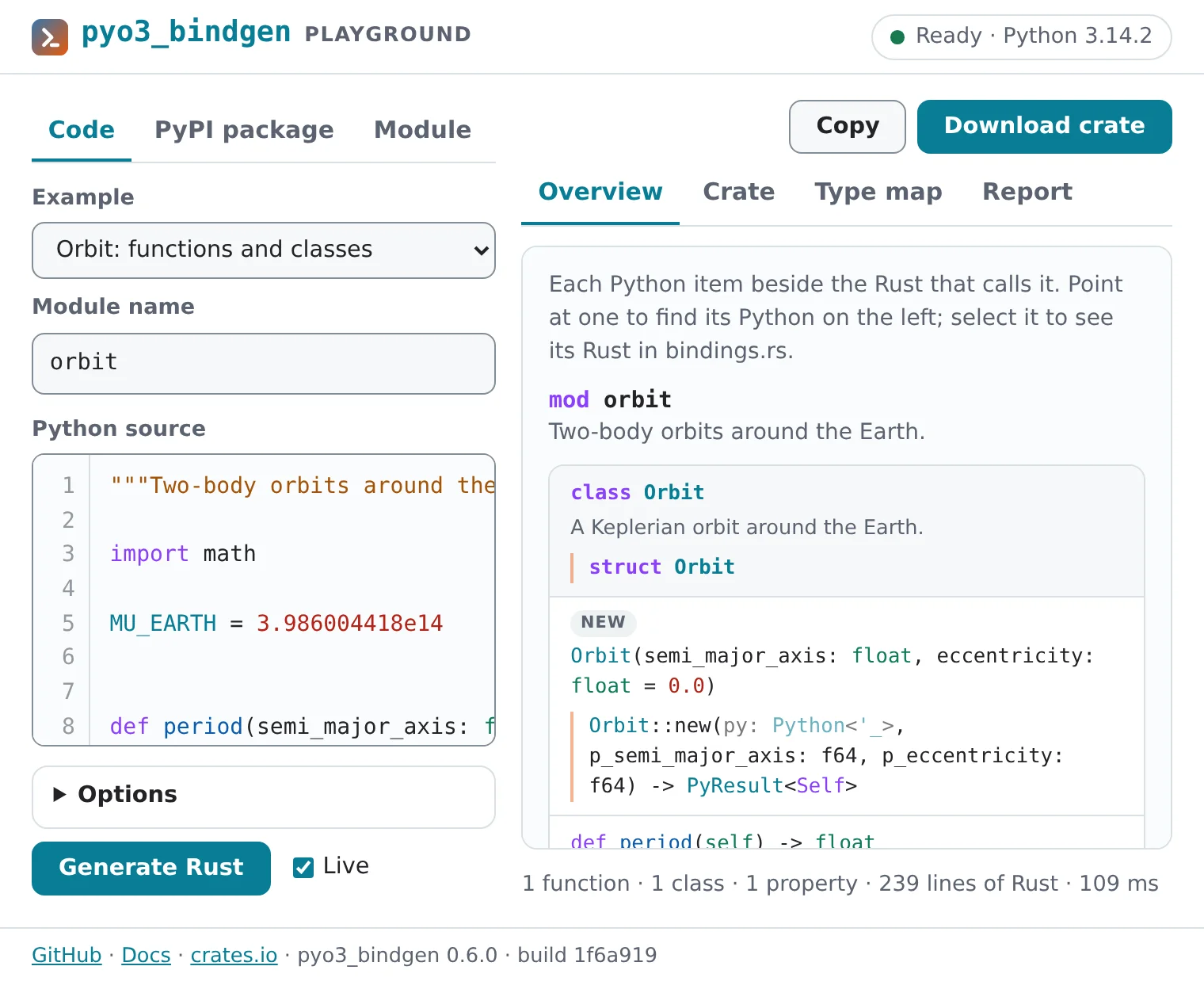
Automatic Rust bindings to Python modules via PyO3. pyo3_bindgen generates Rust bindings to Python modules via PyO3. It walks a module recursively and mirrors its public classes, functions, properties and constants in Rust, keeping docstrings and type annotations. Rust then calls Python through typed functions instead of string lookups, which helps to integrate a Python project with Rust or to port it step by step. For a small Edit Python or name any module, including packages from PyPI, to see the Rust that calls it, then compile and run a program that uses the bindings. Pyodide runs Python, the generator is compiled to WebAssembly, and the Rust compiler runs in a Linux virtual machine in your browser. The latest release is pyo3_bindgen 0.5.0 (May 2024) on crates.io, dual-licensed under MIT or Apache 2.0. It targets the The generated code still calls into Python, so it is not faster by itself; it is a typed starting point for rewriting the slow parts in Rust. Bindings are only as complete as a module’s structure, annotations and docstrings. Not every Python type has a Rust mapping yet, and the API of the generated bindings may still change.orbit.py module, pyo3_bindgen -m orbit turns float annotations into f64 and docstrings into Rust doc comments, and gives the module constant MU_EARTH a getter and a setter. Live demo
Features
pyo3_bindgen::Codegen from build.rs, optionally customized with pyo3_bindgen::Config, and include! the generated file.import_python!("math") with the macros feature generates bindings in place.cargo install --locked pyo3_bindgen_cli, then pyo3_bindgen -m os sys numpy -o bindings.rs to inspect bindings for any importable module.numpy feature maps NumPy arrays to the numpy crate’s PyArray. Status
Bound<'py, T> API introduced in PyO3 0.21; version 0.4 remains available for the older GIL-Refs API. The playground already runs the upcoming 0.6.0. Links